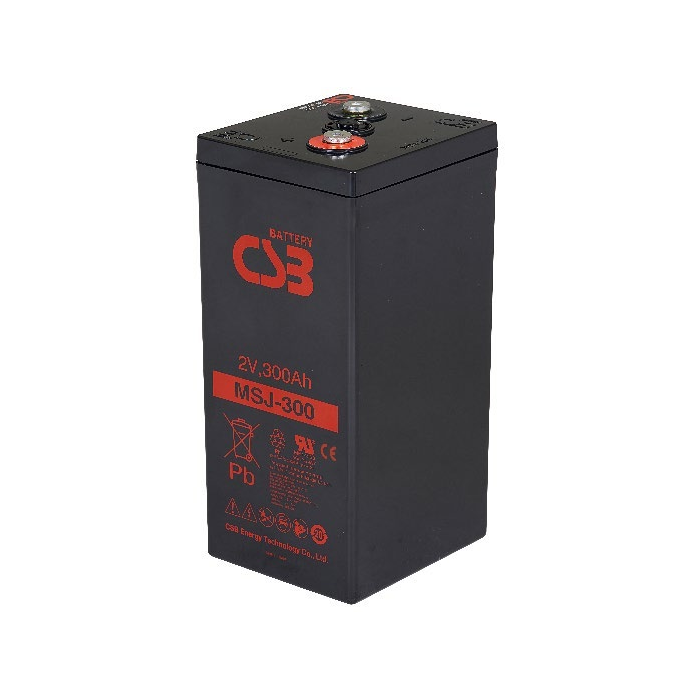
MSJ-300 csb battery 2V300Ah Suitable for Telecom base station DC power backup, Optical access network central office backup, Microwave relay station DC supply, Telecom room 48V DC system
The CSB MSJ-300 is an MSJ series 2V VRLA-AGM battery with a nominal capacity of 300Ah (1.80VPC@25°C, 10-hour rate), designed for telecom float standby applications, with a design float life of up to 20 years, a flame-retardant ABS case and copper alloy terminals.
Taobao store
WeChat procurement
Product Features
- Valve Regulated Lead Acid (VRLA) Battery
- Maintenance-Free, Absorbent Glass Mat (AGM) Technology for Efficient Gas Recombination of up to 99%
- Pure Lead Construction and Proprietary Elements
- Designed for High Capacity Float Service Standby Power Applications
- Built in Accordance with IEC 60896-21/22:2004 and UL1989 Recognized (MH14533)
Application Scenarios
- Telecom base station DC power backup
- Optical access network central office backup
- Microwave relay station DC supply
- Telecom room 48V DC system
- Broadband access equipment backup power
- Mobile core network backup
Product parameters
- Model:MSJ-300
- Voltage:2 Vdc
- Nominal Capacity:300 Ah @10hr-rate
- Ah Capacity:304.00 (8-Hr 1.75 VPC @ 25°C)
- Ah Capacity:314.00 (20-Hr 1.75 VPC @ 25°C)
- Ah Capacity:296.00 (8-Hr 1.80 VPC @ 25°C)
- Max. Charge Current:90.00 A
- Max. Discharge Current:1800 A
- Short Circuit Current:5075 A
- Internal Resistance:0.33 mΩ
- Terminal Type:I4 thread copper alloy terminal to accept M8 bolt
- Terminal Torque:126±25 Kgf·cm / 109±22 Lbf·in / 12.3±2.5 N·m
- Container Material:Flame-retardant ABS (UL 94-V0)
- Weight:21.80 / 48.05 kg / lb.
- Width (W):150.0±1.5 / 5.91±0.06 mm / in
- Height (H):339.0±2.5 / 13.15±0.10 mm / in
- Depth (D):170.0±2.0 / 6.69±0.08 mm / in
- Design Life:Up to 20 years in standby service at 25°C; Eurobat (20°C): >12 years, Very Long Life
- Float Charging Voltage:2.21 ~ 2.25 Vdc/battery
- Equalizing Charging Voltage:2.35 Vdc/battery
- Operating Temperature:discharge -15°C to 50°C; charge/storage -15°C to 40°C
Product details
The CSB MSJ-300 belongs to the MSJ series of 2V valve-regulated sealed lead-acid batteries, using AGM absorbed glass mat technology with a gas recombination efficiency of up to 99%, and is maintenance-free by design. This series targets high-capacity float standby power applications such as telecommunications, and is officially positioned as a 2V high-capacity long-life telecom battery offering a service life of up to 20 years under 25°C float conditions.
In terms of capacity, the MSJ-300 has a nominal capacity of 300Ah (1.80VPC@25°C, 10-hour rate); at 25°C, the 8-hour rate at 1.75VPC is 304.00Ah, the 20-hour rate at 1.75VPC is 314.00Ah, and the 8-hour rate at 1.80VPC is 296.00Ah. The battery's maximum charge current is 90.00A, maximum discharge current is 1800A, short-circuit current is 5075A, and internal resistance is 0.33mΩ.
Structurally, the MSJ-300 uses a pure lead construction with proprietary formulation elements, and the case material is flame-retardant ABS (UL 94-V0). The terminals are I4 threaded copper alloy terminals that accept M8 bolts, with a terminal torque of 126±25 Kgf·cm, 109±22 Lbf·in or 12.3±2.5 N·m. Dimensions are 150.0±1.5mm wide, 339.0±2.5mm high and 170.0±2.0mm deep, and weight is 21.80kg.
For charging and temperature conditions, at 25°C the float charge voltage is 2.21 to 2.25Vdc/battery, and the equalizing charge voltage is 2.35Vdc/battery. The nominal operating temperature is 25°C, the discharge range is -15°C to 50°C, and the charge and storage range is -15°C to 40°C. For self-discharge, it is below 10% after 90 days at 25°C, and it can be stored for up to 6 months; a full charge is required before use, and if the storage temperature is above 25°C it should be charged sooner.
The MSJ-300 is manufactured in accordance with IEC 60896-21/22:2004 and is recognized under UL1989 (MH14533). Its design life reaches up to 20 years under 25°C float conditions, and under the Eurobat (20°C) standard it is rated Very Long Life at greater than 12 years, making it suitable for applications such as telecommunications that require long-term float standby.